
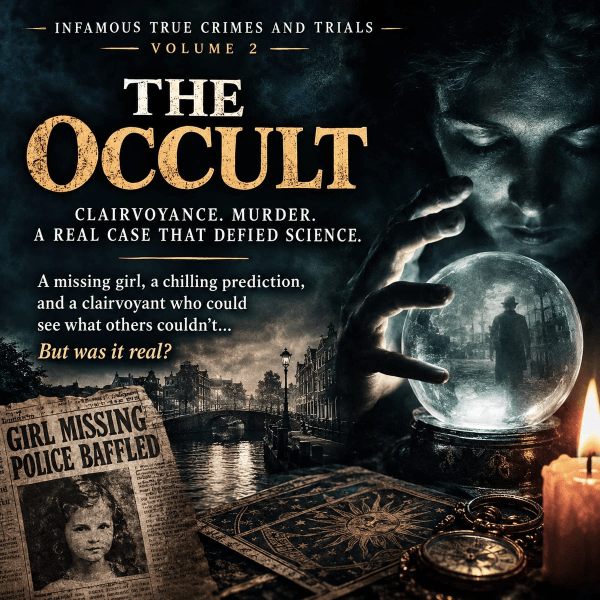
The Occult: When the Unexplained Crossed Into the World of Crime
What if a missing person could be found by someone who had never seen them?
What if a murder investigation could be helped by a man who claimed to know what had happened simply by sitting near the suspect?
And what if a supposedly haunted house became the scene of events witnessed by investigators, journalists and ordinary people for more than a decade?
For centuries, people have argued about the existence of supernatural powers. Some dismiss them as superstition, coincidence or clever deception. Others believe there are aspects of the human mind - and perhaps the world around us - that science has yet to explain.
But occasionally, the occult has crossed paths with something far more concrete: crime and criminal investigation.
The stories collected in The Occult, from Infamous True Crimes and Trials Volume 2, explore some of the strangest examples: clairvoyants who claimed to assist police, a notorious haunted house in England, and one of the most controversial figures ever to associate himself with the occult.
These are stories where fact, belief, coincidence and mystery become remarkably difficult to separate.
When A Clairvoyant Became Involved In Murder
In June 1943, a young Dutch house painter named Pieter Van der Hurk suffered a terrible accident.
He fell around 30 feet from a ladder and was taken to hospital in The Hague with a fractured skull and broken shoulder.
But when he regained consciousness, something extraordinary seemed to have happened.
A nurse was holding his wrist and taking his pulse when Van der Hurk suddenly told her that he could see her on a train - and that she had left a friend's suitcase behind.
The nurse was astonished.
She had, in fact, arrived by train and had accidentally left a friend's suitcase in the dining car.
Van der Hurk could not explain how he knew.
The experience was not an isolated incident. He began making apparently inexplicable statements about people around him, describing personal details he could seemingly have had no normal way of knowing.
The accident had changed his life.
Pieter Van der Hurk would eventually become internationally known as Peter Hurkos, one of the most famous clairvoyants of the twentieth century.
And before long, his alleged abilities attracted the attention of police.
In 1958, Hurkos was asked by police in Miami to sit inside the cab of a murdered taxi driver and give his impressions of the killer.
According to the account, he described the murder and then gave investigators a description of the suspected murderer.
The man, he said, was tall and thin, had a tattoo on his right arm and walked with a rolling gait. Hurkos also gave him the nickname "Smitty" and claimed he was connected to another killing.
Police eventually connected the description with a sailor named Charles Smith.
Smith was arrested after being recognized in New Orleans and was returned to Miami. He was subsequently charged with the taxi driver's murder and sentenced to life imprisonment.
Whether Hurkos genuinely possessed some unexplained ability or was relying on observation, intuition or information unknown to the public remains a matter of interpretation.
But cases such as this raised a fascinating question:
Can the human mind sometimes know things it has no obvious way of knowing?
Can The Mind See Beyond What The Eyes Can See?
The story of Hurkos was not unique.
Another Dutch clairvoyant mentioned in the original account was Gerard Croiset, who was also reported to have assisted in investigations.
The two men became subjects of interest to researchers studying parapsychology - the investigation of phenomena such as telepathy, clairvoyance and precognition.
One proposed explanation involved the idea of synchronicity, a concept associated with psychologist Carl Jung.
The basic idea is intriguing: sometimes events appear to coincide in ways that seem too meaningful to be explained by ordinary chance.
Most of us have experienced something similar on a much smaller scale.
You think about somebody you haven't seen for years - and suddenly they telephone.
You hear an unusual name for the first time, then encounter it several more times that same day.
You dream about something and later experience something strangely similar.
Usually, we dismiss such things as coincidence.
But what if, occasionally, they are something more?
The original story also discusses experiments designed to test precognition, including attempts to determine whether people can predict randomly generated events at a rate significantly greater than chance.
The results reported in the source are intriguing, although they certainly do not provide a universally accepted explanation for psychic phenomena.
Perhaps that is what makes the subject so fascinating.
The possibility of unexplained mental abilities sits somewhere between science and mystery.
And crime investigations have occasionally provided some of the most extraordinary examples.
The Murder Case Solved By A Thought Reader
One of the strangest cases described in the story occurred in Canada in 1928.
The Booher family operated a farm near Manville, Alberta.
On July 9, four people were found dead on the property.
They had all been shot with a .303 rifle.
The victims included members of the Booher family and two farmhands.
There appeared to be no obvious motive.
Nothing had been stolen.
Police eventually discovered that the murder weapon belonged to a neighbour, Charles Stephenson. But Stephenson insisted that his rifle had been stolen several days earlier.
The investigation appeared to be going nowhere.
Then police heard about a Viennese psychic named Dr. Maximilien Langsner, who had reportedly assisted police in another case involving stolen jewellery.
Langsner agreed to help.
After attending the inquest, he told police that the murderer was not a mysterious outsider.
It was Vernon Booher, the man who had discovered the bodies.
Langsner also claimed he knew where the murder weapon had been hidden.
He led police to a patch of prairie grass.
The rifle was there.
But there was still one major question.
Why had Vernon Booher killed four people?
Langsner claimed he could discover the answer if he were allowed to spend some time near the suspect.
Booher was being held in Edmonton as a material witness. Langsner sat outside his cell, apparently doing nothing except staring into space.
After an hour, he went to the police chief.
He claimed that he now knew the motive.
According to Langsner, Vernon had wanted to marry a local farmer's daughter, but his mother had refused to give her consent.
A confrontation followed.
The situation turned violent, and Vernon shot his mother.
He then killed his brother and two farmhands because they might have been able to identify him.
But could Langsner's story be proved?
Police confronted Booher with a witness named Erna Higgins, who had apparently seen him leaving church around the time the rifle was stolen.
When she confronted him, Booher broke down and confessed.
According to the original account, his confession matched Langsner's description of events in detail.
Vernon Booher was eventually hanged.
Langsner continued his research into what he called "brain waves", eventually moving to Alaska, where he died several years later.
Was Langsner genuinely reading minds?
Was he exceptionally perceptive?
Had he somehow obtained information through conventional means?
Or was something else happening?
There is no simple answer.
And that uncertainty is precisely what makes these old cases so compelling.
Borley Rectory: Britain's Most Haunted House?
If clairvoyants and unexplained mental phenomena were strange enough, Britain had another mystery waiting.
It stood in the small village of Borley in Essex.
Borley Rectory had become famous as what was described as England's most haunted house.
And eventually, the house itself would disappear in a spectacular fire.
The Rectory was built in 1863.
According to local tradition, the site had once been connected with a monastery and a tragic story involving a monk and a nun.
The legend claimed that the nun had fallen in love with the monk and attempted to escape with him.
They were caught.
The monk was executed and the nun was supposedly walled up alive.
There was little historical evidence supporting the story, and later investigation cast doubt on important parts of it.
Yet the legend became firmly attached to Borley.
Visitors claimed to see the apparition of a nun.
A phantom coach was reportedly seen crossing the grounds.
Strange lights appeared.
Footsteps were heard.
And voices seemed to come from empty rooms.
Then, in 1929, the story attracted the attention of famous ghost investigator Harry Price.
Price was contacted after the occupants of the Rectory reported strange activity.
He arrived to investigate.
And according to the account, he didn't have to wait long.
Stones, Bells And Flying Objects
The reported phenomena at Borley were not limited to ghostly sightings.
Objects allegedly moved without explanation.
A glass candlestick reportedly travelled from an upstairs room into the hall and smashed near Price.
Pebbles and pieces of slate were thrown.
Mothballs appeared to fly through the house.
Service bells rang without anyone pulling them.
Keys apparently moved from locks.
The story quickly became a sensation.
Newspaper coverage attracted sightseers from far and wide.
People crowded into the tiny village hoping to catch a glimpse of the famous ghosts.
The Rectory became so popular that the surrounding lanes were clogged with cars, and even a bus company operated trips to see "The Borley Ghost."
But the occupants of the house were not necessarily amused.
The Reverend G. E. Smith eventually moved away with his family.
In 1931, another clergyman, the Reverend Lionel Foyster, moved into the Rectory.
If the haunting had been a trick, it showed no intention of disappearing.
In fact, according to the reports, the phenomena became even more dramatic.
Mrs. Foyster was allegedly struck by objects and experienced increasingly frightening incidents.
During the first 15 months, her husband recorded more than 2,000 supernatural events.
Some were apparently harmless.
Others were not.
Household objects disappeared and reappeared.
Doors behaved strangely.
Stones and other objects were reportedly thrown through rooms.
Attempts were made to drive away whatever was responsible.
Religious objects were used.
Prayers were said.
Holy water was brought in.
None of it appeared to make a lasting difference.
Then came one particularly bizarre evening.
Mrs. Foyster was eating supper with her maid and another guest while waiting for her husband to return.
A wine bottle suddenly appeared and smashed beneath a chair.
Another bottle followed.
Then another object reportedly appeared from nowhere and rolled into the room.
The incidents occurred against a background of ringing bells.
It sounds like something from a supernatural thriller.
But these were reports recorded by people who claimed they had actually experienced them.
The Investigators Arrive
Eventually, Harry Price obtained an opportunity to conduct a more extensive investigation of Borley Rectory.
This time he wanted something different.
He wanted observers who could approach the house scientifically.
His team included people from different professional backgrounds, including scientists, university graduates, doctors and engineers.
The BBC even sent sound engineers with recording equipment.
The investigators did not simply arrive looking for ghosts.
They were there to determine what could actually be observed.
And some of their reported experiences were difficult to explain.
Objects allegedly moved.
Footsteps and knocking sounds were heard.
The apparition of the nun was reportedly seen again.
One investigator was apparently locked inside a room even though the key was on the inside.
But perhaps the most intriguing reports involved writing.
Investigators claimed that marks appeared on walls while they were watching.
Earlier, during the Foysters' occupation, messages had apparently appeared asking for help.
Automatic writing using a planchette produced further messages, including claims that the supposed spirit was a French nun named Marie who had been murdered.
Of course, automatic writing itself is not proof that a supernatural entity exists.
It can be produced through unconscious muscular movement and other psychological mechanisms.
But Borley had now developed into something much larger than a simple ghost story.
It had become a mystery that attracted investigators, journalists, sceptics and believers alike.
The Prediction That Came True
Then came perhaps the most extraordinary episode of all.
On March 27, 1938, Helen Grenville was reportedly conducting a séance at her home in Streatham, London.
The planchette began to move.
A message was supposedly produced predicting that Borley Rectory would be destroyed by fire.
More remarkably, the message claimed that human bones would be discovered beneath the ruins.
The fire did not occur that night.
Months passed.
Then, on February 27, 1939, Borley Rectory finally caught fire.
The tenant, Captain Gregson, was in the hall sorting books when a pile apparently fell from a bookcase onto a paraffin lamp.
The lamp broke.
Within minutes, the building was ablaze.
The famous Rectory was destroyed.
And later, bones were found among the ruins.
They were assumed to be the remains of the woman whose ghost was supposed to haunt the house and were subsequently reburied.
But the story did not end there.
Sceptics later challenged Harry Price's methods and questioned the authenticity of many of the phenomena.
Mrs. Eric Smith, whose husband had been involved in the original story, claimed that the strange events had occurred primarily when Price was present.
The Society for Psychical Research later criticized aspects of Price's investigation and suggested that some of the phenomena may have been caused by Mrs. Foyster.
So was Borley Rectory genuinely haunted?
Or was it an elaborate combination of suggestion, deception, coincidence and human psychology?
Even today, the story refuses to provide a comfortable answer.
Aleister Crowley: The Man Who Became The Beast
The final story takes us from haunted houses and clairvoyants into the courtroom.
Few people in the history of the occult have attracted as much notoriety as Aleister Crowley.
Crowley cultivated an extraordinary public image.
He called himself "The Beast 666", among several other grandiose titles, and built a reputation around magic, mysticism, ritual and rebellion against conventional morality.
But in 1934, something remarkable happened.
Crowley went to court claiming that he had been libelled.
He was seeking damages.
Instead, the trial became a public examination of his extraordinary life and writings.
It was almost as though Crowley had walked into court intending to clear his name - and inadvertently given his opponents an opportunity to put his entire reputation on trial.
The judge, Mr Justice Swift, was appalled by what he heard.
Crowley's own books became evidence.
His beliefs, writings and claims were examined in detail.
The prosecution questioned him about his adoption of the name "The Beast 666" and his other occult titles.
Crowley often responded with characteristic flippancy.
But his strategy was beginning to unravel.
His opponents had discovered that the best way to challenge Crowley's reputation was not necessarily to attack him personally.
They simply had to allow him to explain it himself.
And that proved devastating.
When The Beast Took The Witness Stand
Crowley's counsel had attempted to present him as an eccentric scholar, poet and traveller.
The defence, however, had access to his own published material.
His writings contained descriptions of rituals, magic and behaviour that were difficult to reconcile with the respectable image his lawyers were trying to present.
The questioning became increasingly uncomfortable.
At one point, Crowley was challenged about his claims concerning magical rituals and supernatural powers.
He was even invited to demonstrate some of them.
Could he attack somebody using magic?
Could he make himself invisible?
Crowley declined.
The judge eventually intervened when counsel's questioning threatened to turn the courtroom into what he jokingly described as a "temple."
It was an extraordinary courtroom spectacle.
But the real damage had already been done.
The jury had heard Crowley explain his own beliefs and had been confronted with passages from his books.
Then Betty May, the wife of Raoul Loveday, gave evidence about her experiences at Crowley's community in Sicily.
Loveday had died there in 1923 after becoming seriously ill.
May described the environment at the Abbey of Thelema and the rituals she had witnessed.
Her evidence added another disturbing dimension to the proceedings.
By the time the trial reached its final stage, Crowley's attempt to restore his reputation had effectively turned against him.
The Verdict
The jury did not need long.
During the fourth day of the trial, the jurors began discussing the case among themselves.
The judge noticed.
Eventually, they asked whether they could intervene.
When asked whether the case should continue, the foreman gave a simple answer:
No.
The jury returned a verdict in favour of Nina Hamnett and her publishers.
Crowley received no damages.
The man who had entered court hoping to defend his reputation had instead suffered one of the most spectacular public humiliations of his career.
He left the courtroom a defeated man.
His reputation, already notorious, had been damaged further by the evidence heard during the trial.
Crowley would live for another decade before dying in relative obscurity in Hastings in 1947.
But the legend he had carefully created around himself survived him.
And perhaps that is the strangest thing about Aleister Crowley.
Was he genuinely convinced that he possessed supernatural powers?
Was he a brilliant showman who understood the power of publicity?
Was he a sincere occultist whose beliefs became increasingly extreme?
Or was he some combination of all three?
The court could deliver a verdict on the libel action.
It could not deliver a verdict on the mysteries surrounding Crowley himself.
Where Does The Truth End And The Occult Begin?
The three stories in The Occult are separated by years, countries and circumstances.
Yet they have something important in common.
Each presents a situation in which people claimed to encounter something beyond ordinary explanation.
Peter Hurkos appeared to know things he seemingly could not know.
Maximilien Langsner claimed to read the mind of a murder suspect.
At Borley Rectory, witnesses reported phenomena that appeared to defy normal explanation.
And Aleister Crowley built an entire identity around the mysterious and supernatural - only to have that identity exposed and challenged in a London courtroom.
There is an obvious temptation when looking at stories like these to choose one side immediately.
Either everything was genuine - or everything was nonsense.
But perhaps the more interesting position is somewhere in between.
Human beings are extraordinarily good at finding patterns.
We can also deceive ourselves, deliberately or otherwise.
Memory can change.
Rumours grow.
Coincidences can appear meaningful.
People can be manipulated.
And fraud certainly exists.
But that does not necessarily mean every unexplained event has a simple explanation.
That is what makes the history of the occult so fascinating.
Some mysteries are eventually solved.
Others remain disputed.
And a few continue to sit stubbornly in that uncomfortable territory between what we believe is possible and what we can actually prove.
Perhaps the most intriguing question is not "Do ghosts, clairvoyants or psychic powers exist?"
It is this:
How much do we really understand about the human mind - and how much of the world around us remains unexplained?
That question has haunted investigators for generations.
And, judging by these remarkable cases, it probably isn't going away anytime soon.
The Occult appears in Infamous True Crimes and Trials, Volume 2, where these and other extraordinary cases explore the darker and stranger corners of criminal history, mystery and the courtroom.

Blog written by Guy Hadleigh, author of Crimes That Time Forgot, the Macabre True Crimes & Mysteries Series, the Murder and Mayhem Series, the British Killers Series, the Infamous True Crimes and Trials Series - and many more!
Have questions?