
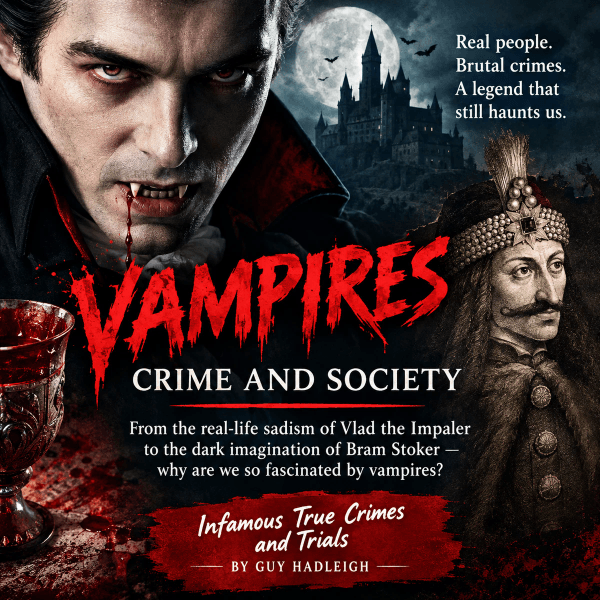
Vampires: When the Monsters Were Real
For centuries, people have been fascinated by vampires.
They have appeared in folklore, literature, theatre, films and popular culture, usually portrayed as elegant creatures of the night who rise from their graves to feed on the living. They are supposed to fear daylight, garlic and crucifixes. They cannot be seen in mirrors. They sleep in coffins and, according to the old legends, can only be destroyed by a stake through the heart.
But where did the vampire legend come from?
And perhaps the more disturbing question is this:
What if some of the most terrifying stories about vampires were inspired not by supernatural creatures, but by real human beings?
The history behind the vampire myth is a strange mixture of ancient superstition, psychological fascination, folklore, crime and some extraordinarily disturbed individuals.
Among the names associated with the legend are Vlad the Impaler, the brutal Wallachian ruler who helped inspire Bram Stoker's Dracula, and two very real twentieth-century murderers whose crimes gave the word "vampire" a chillingly literal meaning.
One drank the blood of his victims after murdering them.
Another became known as the Vampire of Düsseldorf.
Their stories reveal something unsettling about the vampire myth: perhaps the creature has always represented something that exists much closer to home.
Vlad the Impaler: The Man Behind Dracula
When Bram Stoker published Dracula in 1897, he created the world's most famous vampire.
His Count Dracula was a mysterious Transylvanian aristocrat, an apparently refined gentleman hiding a monstrous nature. But behind the fictional character was a very real historical figure.
Vlad III of Wallachia, better known as Vlad the Impaler.
Vlad was born into a violent world. Wallachia, now part of Romania, was politically unstable and threatened by powerful enemies. Rival noblemen fought among themselves, foreign powers exerted pressure and the country's rulers had a remarkably short life expectancy. According to the account in the original story, twenty rulers had occupied the throne in less than forty years.
Vlad had already experienced extreme violence personally. His father had been murdered and his brother buried alive.
When Vlad came to power in 1456, he responded to his enemies with extraordinary brutality.
Opposing noblemen were killed and their families destroyed. Merchants were seized and executed. Foreign ambassadors who failed to show him sufficient respect were punished in horrifying fashion.
But Vlad's preferred method of execution was the one that gave him his infamous nickname.
Impaling.
Victims were placed upon sharpened stakes, with their own weight gradually forcing their bodies downward. The method was deliberately agonising and could result in a prolonged death.
Vlad's reputation became so terrifying that his name eventually became synonymous with cruelty.
Yet there was another detail in the historical accounts that would prove particularly useful to the emerging vampire legend.
Some German chronicles claimed that Vlad drank the blood of his victims.
Whether every detail recorded about Vlad was true is another matter. Medieval accounts were often exaggerated, politically motivated or designed to shock. But the association between Vlad and blood was enough to help create one of the most enduring fictional monsters in history.
Bram Stoker took the name Dracula and elements of Vlad's reputation and transformed them into something entirely new.
The historical tyrant became the supernatural Count Dracula.
Why Are We So Fascinated by Vampires?
That transformation raises an intriguing question.
Why has the vampire remained so powerful in the human imagination?
Vampire stories existed long before Bram Stoker. Ancient Greek and Roman traditions included creatures associated with blood, death and predatory sexuality. The Roman Lamia, for example, was described as a beautiful woman who seduced men before devouring them.
But the vampire that became familiar to modern Western culture developed much later.
During the eighteenth century, reports of supposed vampires began spreading across parts of Eastern Europe.
One of the most famous cases concerned a young soldier named Arnold Paole, who returned to his village in 1727 claiming that he had encountered a vampire while serving in Greece.
Paole said that he had found and destroyed the creature's grave.
Then Paole himself died following a serious accident.
That should have been the end of the story.
It wasn't.
Villagers claimed to have seen Paole walking around after his death. Some people who supposedly encountered him later died themselves. Eventually, his grave was opened.
According to the contemporary reports, the body appeared unusually well preserved and blood was said to have been visible around the mouth.
The corpse was burned.
So were the bodies of several other people who had died.
For a time, the reports stopped.
Then, several years later, the panic returned.
The Vampire Panic
In 1732, military and medical investigators examined a number of graves in the region.
Their report described bodies that appeared unusually fresh despite having been buried. Some were said to have ruddy complexions, leading investigators and local residents to believe that they had become vampires.
Today, such descriptions can be interpreted in many different ways.
The decomposition of a human body is not always predictable, particularly when environmental conditions affect the process. Changes in the body after death can easily be misunderstood by people unfamiliar with forensic science.
But to eighteenth-century observers, these discoveries appeared to confirm something far more frightening.
The dead were returning.
Reports of vampires spread through Hungary, Romania and other parts of Eastern Europe. Travellers carried the stories into Western Europe, where they became a subject of fascination.
In 1746, the French scholar Dom Augustin Calmet published a work discussing apparitions and vampires, helping to bring the subject to an even wider audience.
One account concerned a farmer who had supposedly appeared to his family years after his death. His son died shortly afterwards.
The authorities investigated.
The body was reportedly found to be in remarkably good condition despite having been buried for many years.
To modern eyes, such stories may seem like a mixture of superstition, fear and misunderstanding.
But there was another possibility.
Could some apparent vampire cases have involved people who had actually been buried alive?
Before modern medicine could reliably determine death, mistakes were possible. A person who had fallen into a coma or suffered a condition resembling death might conceivably have been buried and later discovered in an unusual position.
Other writers proposed more supernatural explanations, including the idea of apparitions or so-called astral projection.
Whether such phenomena have any basis in reality remains a matter of belief rather than established science.
But the vampire legend had already taken hold.
And gradually, it became associated with something that was much more recognisably human:
bloodlust.
The Human Vampire
The vampire myth is often treated as a supernatural story, but some of its darker elements reflect real psychological behaviour.
There have been documented cases of people who developed obsessions involving blood, death, violence and corpses.
One historical example was Sergeant François Bertrand, a French soldier who was convicted in 1849 after robbing graves and abusing corpses.
Bertrand reportedly appeared outwardly respectable. He was an admired soldier and could maintain ordinary relationships with women.
But beneath that conventional exterior existed a disturbing private obsession.
His case illustrates one of the recurring themes of vampire stories: the terrifying possibility that a seemingly ordinary person may be hiding an entirely different personality.
The same idea appears repeatedly in Gothic literature.
The monster does not necessarily look like a monster.
He may be charming.
Polite.
Well dressed.
Apparently respectable.
And that brings us to two of the most disturbing real-life cases connected with the vampire legend.
John George Haigh: The Acid Bath Blood Drinker
In the late 1940s, residents of London's elegant Onslow Court Hotel regarded John George Haigh as a charming and well-mannered gentleman.
He smiled.
He behaved courteously.
He appeared successful.
To some of the older female residents, he was almost like a favourite nephew.
One of those women was 69-year-old Olive Durand-Deacon, a wealthy widow who had developed a friendship with Haigh.
She had designed a form of artificial fingernail and was interested in finding someone who could help develop the idea.
Haigh offered to assist her.
He suggested that she visit a factory in Crawley, Sussex, where they could supposedly examine materials.
It was a trap.
On February 18, 1949, Haigh drove Mrs Durand-Deacon to Crawley.
But the factory was not what she believed it to be.
Haigh had prepared the premises in advance.
There was sulphuric acid.
A large chemical drum.
Protective clothing.
Equipment for handling the corrosive substance.
He had not brought his unsuspecting acquaintance there to discuss artificial fingernails.
He intended to murder her.
After killing her, Haigh attempted to dispose of her body using the acid he had prepared.
Then he did something that would later give the newspapers one of their most sensational headlines.
He drank some of her blood.
The bizarre ritual was not an isolated act.
Haigh later claimed that he had drunk blood after each of his murders.
But Haigh had made one serious mistake.
He had assumed that nobody knew about his meeting with Mrs Durand-Deacon.
A friend of hers did.
When Mrs Durand-Deacon failed to return, suspicions began to grow.
Haigh was eventually questioned by police.
A policewoman who interviewed him was unconvinced by his smooth manner. She reported that something about him seemed wrong.
Police checked his background.
They discovered previous convictions for fraud and theft.
Then they searched the factory.
There they found acid containers, a rubber apron bearing traces of blood, equipment and a revolver that had recently been fired.
Haigh's carefully constructed story began to collapse.
And then he made an extraordinary confession.
He told detectives that Mrs Durand-Deacon no longer existed because he had destroyed her body with acid.
He believed he had found the perfect murder method.
No body.
No murder.
No evidence.
He was wrong.
Investigators recovered material from the site and sent it for examination.
Among the remains were fragments of human bone. Most significantly, they discovered dentures that were identified as belonging to Mrs Durand-Deacon.
The evidence was devastating.
It also led investigators to examine Haigh's past more closely.
They discovered that he had already murdered several other people and used similar methods to dispose of their remains.
Haigh had not been an isolated killer.
He was a serial murderer.
And his obsession with drinking blood became a major part of the public fascination surrounding the case.
The British press quickly seized upon the vampire angle.
On March 4, 1949, the Daily Mirror published a sensational headline:
"Vampire — A Man Held."
Haigh's trial became a national sensation.
His defence attempted to raise questions about his mental state and his bizarre blood-drinking ritual. But the jury was not persuaded.
After a short deliberation, Haigh was found guilty and sentenced to death.
The supposed vampire was, in the end, entirely human.
The Vampire of Düsseldorf
If John George Haigh demonstrated how a murderer could exploit the vampire myth, the case of Peter Kürten demonstrated something even more frightening.
Kürten was not an obviously frightening man.
Quite the opposite.
He was quiet, polite and neatly dressed.
People who knew him found it difficult to believe that he could possibly be the monster responsible for terrifying an entire city.
In 1929, Düsseldorf was gripped by fear.
A mysterious attacker seemed to be striking without warning.
People stopped going out at night.
Children were hurried home.
Doors were locked.
The newspapers warned of an unknown predator.
The killer became known as the Vampire of Düsseldorf.
The name was not merely theatrical.
Blood appeared repeatedly in the crimes, and the attacks were so brutal that the police struggled to understand the mind behind them.
Then came the breakthrough.
A young woman named Maria Budlick encountered a man who offered to help her find accommodation.
The meeting eventually took her into woodland, where his intentions became clear.
But Maria survived.
More importantly, she remembered where the man lived.
She remembered the name of his street.
A letter she wrote about the experience was accidentally opened by another woman, who immediately contacted the police.
Investigators accompanied Maria back to the address.
She recognised the man.
His name was Peter Kürten.
At that point, Kürten realised that his carefully protected secret was in danger of being exposed.
He eventually confessed.
"I am the Monster of Düsseldorf."
Inside the Mind of the Vampire
Kürten's trial began in 1931.
Thousands of people gathered outside the courthouse, desperate to see the man who had terrorised their city.
Inside, the contrast was extraordinary.
The man in the courtroom did not resemble a cinematic monster.
He was immaculately dressed, with neatly parted hair and polished shoes.
He could have been a shopkeeper.
A clerk.
A respectable office worker.
Instead, he was responsible for a catalogue of crimes that horrified even experienced investigators.
Kürten eventually admitted to dozens of offences and was charged with nine murders and seven attempted murders.
During the trial, he described his crimes in an unnervingly calm and methodical manner.
Psychiatrists examined him.
Was he insane?
The answer from the medical experts was devastating.
They concluded that he understood what he was doing and was responsible for his actions.
His childhood had been marked by poverty and extreme family dysfunction. He described violence within his home and disturbing influences during his formative years.
As he grew older, his fantasies became increasingly violent.
Prison did not cure him.
Instead, he claimed that his experiences there helped intensify his fantasies and resentment toward society.
Eventually, his violent imagination moved beyond fantasy.
The result was the Düsseldorf terror.
The Face of Evil
Perhaps the most disturbing aspect of the Kürten case was not simply what he had done.
It was how completely ordinary he appeared.
Neighbours described him as courteous.
Employers regarded him as reliable.
Women could find him charming.
His wife apparently had no idea about the extent of his secret life.
Even during the investigation, people struggled to reconcile the quiet man they knew with the figure described in the newspapers.
That is one of the reasons the vampire remains such a powerful metaphor.
The supernatural vampire is frightening because he can appear human while secretly being something else.
Real-life predators can do exactly the same thing.
They do not necessarily have fangs.
They do not have glowing eyes.
They do not sleep in coffins.
They may simply walk among us, smiling politely and behaving exactly as society expects.
The End of the Düsseldorf Vampire
Kürten was eventually convicted on all counts and sentenced to death.
On July 1, 1932, he ate his final meal.
The following morning he was taken to the guillotine at Klingelputz Prison.
He showed little emotion.
Asked whether he had a final wish, he said no.
But there was one final question he had asked the prison psychiatrist.
It was a question so bizarre that it has remained attached to the Kürten story ever since.
He wondered whether, after his execution, he would still be able to hear the sound of his own blood.
It was the final expression of the obsession that had followed him throughout his life.
The Vampire of Düsseldorf was dead.
But the legend survived.
The Vampire Is Still With Us
Perhaps vampires have endured because they represent several of humanity's oldest fears at once.
Death.
Blood.
Sexuality.
Violence.
The unknown.
The possibility that someone who looks completely normal may conceal something monstrous.
Bram Stoker transformed those fears into Count Dracula.
Hollywood turned Dracula into an icon.
But long before and long after Stoker, real people demonstrated that the human imagination does not have to invent monsters.
Sometimes reality provides them.
Vlad the Impaler was a brutal ruler whose reputation helped inspire Dracula.
Arnold Paole became the centre of one of Europe's most famous vampire panics.
John George Haigh murdered for money and drank the blood of his victims.
Peter Kürten terrorised Düsseldorf and became known as its vampire.
None of them possessed supernatural powers.
None needed them.
Their crimes were horrifying precisely because they were human.
Perhaps that is why the vampire legend refuses to die.
The supernatural creature can be dismissed as fantasy.
But the human vampire?
That is something altogether different.
The vampire does not need to rise from a grave.
He only needs to walk through the front door.
And sometimes, the most terrifying monster in the room is the person who looks the most ordinary.
Fascinated by True Crime?
If you enjoyed this blog, there's plenty more waiting to be discovered. Guy Hadleigh has written an extensive collection of gripping true crime books covering serial killers, cold cases, organised crime, forensic investigations, historical murders, and some of the world's most astonishing criminal mysteries.
Every case is meticulously researched and brought to life with cinematic storytelling that places you at the heart of the investigation. Whether you're fascinated by modern forensic breakthroughs or infamous crimes from history, you'll find stories that inform, intrigue and keep you turning the pages.
Explore Guy Hadleigh's growing library of true crime books and uncover the cases that continue to haunt investigators - and captivate readers - around the world.
The full story of “Vampires” appears in Guy Hadleigh's
Infamous True Crimes and Trials - Volume #1
Blog written by Guy Hadleigh, author of Crimes That Time Forgot, the Macabre True Crimes & Mysteries Series, the Murder and Mayhem Series, the British Killers Series, the Infamous True Crimes and Trials Series - and many more!

Have questions?