
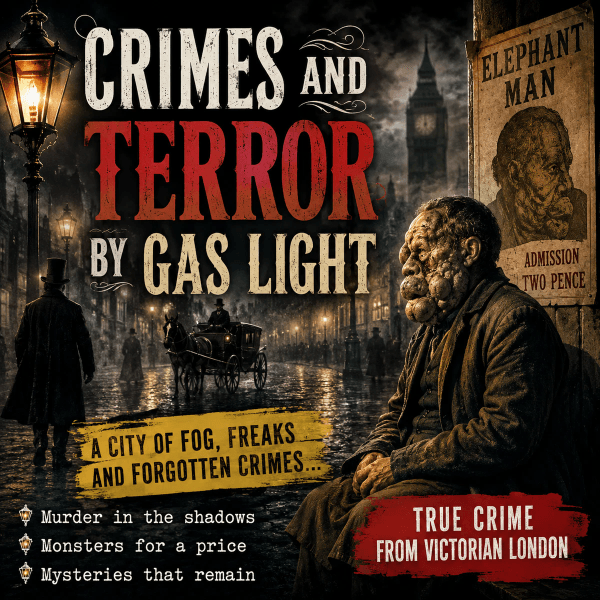
Crimes and Terror by Gas Light: The Dark Side of Victorian Britain
There is something uniquely unsettling about Victorian Britain.
Perhaps it is the image of gas lamps glowing through thick fog, horse-drawn cabs rattling over wet cobbles and shadowy figures disappearing down narrow streets. Perhaps it is the contrast between the respectable façade of Victorian society and the poverty, violence, corruption and crime that existed just beyond it.
Beneath the polished image of Victorian Britain was another world—a world of overcrowded slums, desperate poverty, ruthless criminals, mysterious disappearances and murders that sometimes remained unsolved for decades.
The gaslit streets could be beautiful.
They could also be terrifying.
And some of the crimes committed during this era were so strange that, even today, they seem almost impossible to believe.
This is a journey into that darker world.
A City of Fog, Poverty and Human Curiosities
In the nineteenth century, London was a rapidly expanding city. Population growth, industrialisation and poverty created enormous contrasts between the wealthy and the desperately poor.
The original story opens with an extraordinary encounter that illustrates this darker side of Victorian life.
One cold, foggy evening in the late 1860s, surgeon Sir Frederick Treves was walking along Whitechapel Road when something caught his attention.
A strip of canvas was moving in the wind.
By the dim gaslight, he could make out a sign advertising an attraction:
“Elephant Man, admission two pence.”
Treves entered the makeshift exhibition space and discovered a young man sitting beneath a tarpaulin.
His name was John Merrick.
Merrick's physical deformities were so severe that his appearance shocked almost everyone who saw him. He had been reduced to a sideshow attraction, exhibited to passers-by for money by men who had apparently taken advantage of his vulnerability.
But the story soon took a very different direction.
Treves arranged for Merrick to be taken to hospital, where he was given private rooms and, perhaps for the first time in his life, treated with kindness and dignity.
Despite his terrible circumstances, Merrick proved gentle and grateful. He enjoyed cutting pictures from illustrated magazines, and one of his treasured possessions was a picture of Princess Alexandra.
The princess eventually visited him.
It was an extraordinary meeting between a member of Britain's royal family and a man who had been displayed as a curiosity for paying crowds.
Yet Merrick's story, although tragic, involved no crime.
It serves another purpose in understanding the era.
This was a society in which poverty, exploitation and human suffering could exist almost openly alongside wealth and privilege.
And once the gas lamps illuminated the darker streets, there were plenty of genuine criminals waiting in the shadows.5
The Disappearance of a Baker
One of the strangest cases concerned a German baker named Urban Napoleon Stanger.
Stanger lived with his wife, Elizabeth, at 136 Lever Street, behind Gray's Inn Road. It was a rough neighbourhood, although his bakery business was apparently doing well.
He had also become friendly with another baker, Felix Strumm.
Then, one November night in 1881, Stanger disappeared.
A journeyman baker passing the shop shortly before midnight saw Stanger talking outside with Strumm and two other men. Stanger subsequently went inside.
He was never seen again.
The circumstances surrounding his disappearance immediately aroused suspicion.
When people asked where Stanger had gone, his wife said he had travelled to Germany on business.
But then something happened that made the story considerably more sinister.
Strumm began appearing in public with Elizabeth Stanger.
A few weeks later, neighbours watched as he painted over Stanger's name above the bakery and replaced it with his own.
Rumours began circulating that Stanger had been murdered and his remains disposed of in the bakery.
The police, however, initially found insufficient grounds to act.
Months passed before a £50 reward was offered for information leading to Stanger's whereabouts.
Eventually, Stanger's solicitors brought a case against Strumm for forging a cheque in Stanger's name.
Both Strumm and Elizabeth were detained.
Their explanation was that Stanger had been heavily in debt and had simply left his wife.
But investigators discovered that Stanger had almost £500 in the bank when he vanished. His will also raised further questions because he had left his money to Elizabeth on the condition that she did not marry or live with another man.
Strumm was eventually convicted of forgery and sentenced to ten years.
But the central mystery was never solved.
It seems highly likely that Stanger was murdered, and that Strumm helped Elizabeth dispose of the body.
But nobody ever established precisely how Stanger died—or what happened to his remains.
In Victorian London, a person could simply disappear into the shadows.
And sometimes the shadows never gave them back.
The Skeleton Beneath Euston Square
Another mystery surfaced in 1879 when workmen were clearing rubbish from the cellar of a house at 4 Euston Square.
Beneath the debris they discovered a human skeleton.
It belonged to a woman named Matilda Hacker.
Hacker had been a lodger at the property and was described as an eccentric woman who frequently moved from one lodging to another, partly to avoid creditors.
She had disappeared around eighteen months earlier.
At the time, a maidservant named Hannah Dobbs had claimed that Hacker had simply left.
The discovery of the skeleton changed everything.
Police suspected Dobbs after tracing a gold watch belonging to Hacker to a pawnbroker. Dobbs was eventually put on trial but acquitted because there was insufficient evidence connecting her directly to the murder.
Then came an extraordinary development.
A pamphlet appeared, apparently written by Dobbs herself.
In it, she claimed that Hacker had been murdered by her lover, the younger brother of the man who owned the house—and that she had merely helped conceal the body.
It sounded like a confession.
But why would a woman who had already been acquitted voluntarily implicate herself?
The mystery remained unresolved.
The Woman Who Answered the Door
Some Victorian mysteries began with the most ordinary of events.
On the evening of April 11, 1866, Mrs Sarah Millsom, a housekeeper living in Cannon Street, was sitting reading while her cook, Elizabeth Lowes, worked nearby.
Then the doorbell rang.
Mrs Millsom immediately stood up.
She apparently knew who was calling.
She went downstairs.
When she failed to return, the cook became concerned and followed.
At the bottom of the stairs she found her employer dead.
There had been no robbery. Her keys were untouched, and investigators found no evidence of a sexual motive.
Someone had violently attacked her.
Yet the most baffling question was simply this:
Who had she expected to find at the door?
Mrs Millsom had apparently gone downstairs willingly, expecting someone in particular.
The investigation failed to establish who that person was or why they had wanted her dead.
Another Victorian mystery slipped into the unsolved files.
The Vanishings of East and West Ham
Perhaps the strangest cases were those in which there wasn't even a body.
Beginning in 1881, a series of unexplained disappearances occurred around East Ham and West Ham.
One victim was an eleven-year-old girl named Eliza Carter.
She left home wearing a blue dress.
Later that day she was seen by a friend, apparently terrified. She said she did not dare return home.
Then she disappeared.
Her blue dress was subsequently discovered on East Ham football ground.
Eliza herself was never seen again.
Another disappearance involved Charles Wagner, the son of a West Ham butcher. His body was eventually discovered at the foot of cliffs at Ramsgate, many miles from home.
Yet his death presented another mystery.
There were no obvious injuries and he had not drowned.
Then, in January 1890, three girls disappeared together.
Only fifteen-year-old Amelia Jeffs was subsequently found. She had been strangled following what appeared to have been a struggle.
The disappearances eventually stopped.
But no satisfactory explanation emerged.
Were the victims abducted? Were they victims of a predator? Were the cases connected?
Nobody knew.
The Victorian authorities had little of the forensic technology available to investigators today, and without bodies, witnesses or reliable evidence, some cases simply became mysteries.
Even the strangest theories could find an audience.
The vanishings remain one of the most disturbing examples of how little was known about some crimes committed in Victorian Britain.
The Norwich Mystery That Took Seventeen Years to Solve
The darker side of Victorian crime was not confined to London.
In 1851, a man named Charles Johnson was walking his dog near Norwich when the animal disappeared behind a hedge.
When it returned, it was carrying what appeared to be a piece of flesh.
Johnson eventually realised that it was a human hand.
Police were called.
More human remains were discovered in the surrounding countryside, including a female pelvis. Investigators concluded that the victim was a teenage girl who had been dead for approximately two weeks.
The newspapers seized upon the story.
The public imagined that a murderer was roaming the countryside.
More remains appeared—hands, feet and other body parts—turning the investigation into one of the most sensational mysteries in East Anglia.
But the apparent victim eventually turned out not to be the missing girl people had suspected.
And the case went cold.
Then, seventeen years later, the mystery suddenly returned.
On New Year's Day 1869, a haggard-looking man entered a London police station.
His name was William Sheward.
He wanted to confess to murder.
The crime had occurred in Norwich in 1851.
But the victim was not the teenage girl everyone had assumed.
She was his wife, Martha Francis.
Sheward explained that they had quarrelled about money. During the argument, he attacked her with a razor and killed her.
He subsequently attempted to dispose of her remains by cutting up the body and scattering parts around the countryside.
The horrifying discovery that had once caused newspapers and public opinion to focus on a supposed teenage victim had actually been the result of a completely different crime.
For seventeen years, Sheward had lived with the secret.
Eventually, he could no longer bear it.
He was convicted and executed in 1869.
Charles Peace: The Man with a Thousand Faces
If Victorian Britain had a criminal who seemed to have stepped out of a fictional adventure story, it was Charles Peace.
Peace was a burglar, thief, murderer, escape artist and master of disguise.
He could apparently alter his appearance so dramatically that even experienced policemen struggled to identify him.
At one point, he was arrested under the name John Ward.
Police knew the prisoner was a dangerous man, but they didn't know who he really was.
Then a woman arrived at the jail.
Her revelation stunned the officers.
The man in the cell was not John Ward.
He was Charles Peace.
Peace had already developed a reputation as one of Britain's most elusive criminals.
His physical agility was remarkable. He could climb, squeeze through narrow spaces and move across rooftops with extraordinary speed.
He also possessed a theatrical streak.
He could play the violin, perform, act and entertain.
And those talents became useful when he turned to burglary.
His violin case did not necessarily contain a violin.
It could contain the tools of a professional housebreaker.
Peace became notorious for moving across rooftops at night, entering houses and disappearing before anyone realised a burglary had occurred.
His disguises became legendary.
He could change his hair, complexion and facial appearance, sometimes presenting himself as a completely different person.
He even once stopped beside a police poster bearing his own name and reportedly asked an officer whether they had caught the notorious Peace yet.
But Peace's criminal career eventually moved from burglary to murder.
His obsession with a neighbour, Katherine Dyson, became increasingly disturbing. After she rejected him, he began following her and her husband, threatening them and appearing around their home.
Eventually, Peace confronted Mrs Dyson with a revolver.
The Dysons took the matter to court.
Peace responded by disappearing.
But his obsession had become uncontrollable.
In 1876, Police-constable Nicholas Cock encountered a suspicious figure during a night patrol.
The man produced a revolver.
Cock courageously moved towards him.
Two shots were fired.
The young policeman was fatally wounded.
Peace escaped.
For a time, the wrong men were blamed for the killing.
One of them, William Habron, was convicted and sentenced to death before his sentence was commuted to imprisonment.
Peace, meanwhile, continued his extraordinary criminal career.
Eventually he murdered Arthur Dyson.
A nationwide manhunt followed.
Yet even then Peace seemed almost impossible to catch.
He escaped from police raids, travelled under assumed names and even lodged in the home of a police sergeant while secretly carrying out burglaries in the area.
Finally, in London, his luck ran out.
A policeman spotted signs of a burglary at a mansion.
Peace attempted to escape.
He fired at the pursuing officers but was eventually overpowered.
His real identity was established.
This time there would be no escape.
Peace was convicted.
Then, during the final stages of the case, he confessed.
Most importantly, he admitted responsibility for the murder of Police-constable Cock.
Ballistic evidence supported his confession, and William Habron was eventually released from prison.
Charles Peace was executed at Armley Jail in February 1879.
In a final twist of fate, the executioner was William Marwood—the same man Peace had encountered by chance on a train years earlier.
Neither man could have known that their bizarre meeting would one day acquire such significance.
James Blomfield Rush: Murder for Money
Perhaps the most chilling story in the collection is that of James Blomfield Rush.
Unlike Charles Peace, Rush did not rely primarily on disguises and acrobatics.
His weapons were hatred, manipulation and greed.
The story begins at Stanfield Hall in Norfolk.
When police arrived, they found the aftermath of a devastating attack. Isaac Jermy and his son were dead, while others had been seriously wounded.
The police already suspected James Blomfield Rush.
He lived at Potash Farm, approximately a mile away.
Rush had a long history of hostility towards the Jermy family.
He was deeply in debt and believed Isaac Jermy had treated him unfairly.
His financial problems became increasingly desperate.
Then he devised a plan.
If he could somehow remove the Jermys, manipulate the ownership documents and eliminate his debts, he could potentially transform his fortunes.
His scheme involved forged documents, false claims and ultimately murder.
Rush attempted to create evidence suggesting that other people were responsible for what was about to happen.
But there was one fatal weakness in his plan.
He forged a warning note and signed it in the name of Thomas Jermy.
There was just one problem.
Thomas Jermy could not write.
Rush had inadvertently created evidence that could later be used against him.
The trial became one of the most extraordinary spectacles of Victorian criminal justice.
Surviving witnesses identified Rush as the gunman.
One of them was Eliza Chestney, who had been badly wounded during the attack but survived to give evidence.
Another servant also identified the attacker as Rush.
But the most damaging witness was Emily Sandford.
She had been Rush's mistress.
Her evidence placed him away from home for considerably longer than he later claimed.
She also described his behaviour when he returned—agitated, pale and apparently desperate to establish an alibi.
Rush attempted to undermine her testimony himself.
His approach became increasingly aggressive.
But rather than helping him, his attacks on Emily Sandford exposed the desperation behind his defence.
Then came another devastating moment.
A handwriting expert testified that the supposedly genuine documents were actually written by Rush.
And Thomas Jermy himself was called.
The questioning was extraordinarily brief.
Could he write?
No.
That was all the prosecution needed.
The man whose name Rush had forged could not even have written the signature appearing on the incriminating document.
Rush nevertheless refused to give up.
He represented himself and delivered an extraordinary fourteen-hour defence.
It was a rambling mixture of protestations of innocence, religious appeals and attacks on the prosecution.
Afterwards, the jury needed only ten minutes to reach its verdict.
Guilty.
Rush was sentenced to death.
On April 21, 1849, an enormous crowd gathered around Norwich Castle to witness his execution.
Even at the end, Rush maintained that he was innocent.
His final words were directed towards the executioner.
Then the trapdoor opened.
James Blomfield Rush was dead.
But the story had one final tragedy.
Emily Sandford, the woman whose testimony had helped secure his conviction, attempted to rebuild her life in Australia.
She was supported by a sympathetic local squire who helped her travel there and begin again.
But her notoriety followed her.
She was harassed and persecuted, and struggled to find work.
Eventually, she took her own life.
In that sense, the consequences of Rush's crimes continued long after his execution.
The Dark Side of the Gaslit Age
The Victorian era produced extraordinary advances in science, industry, medicine and culture.
It also produced extraordinary crime.
These stories reveal a society in which police forces were still developing, forensic science was in its infancy and communication was painfully slow by modern standards.
A person could disappear and leave behind little evidence.
A murderer could create an alibi and exploit the limitations of the investigation.
A criminal such as Charles Peace could reinvent himself through disguise and escape capture repeatedly.
And a man such as James Blomfield Rush could attempt to manipulate the legal system through forged documents and sheer force of personality.
Yet there was another side to these cases.
For all the limitations of Victorian justice, determined investigators, witnesses and ordinary citizens sometimes managed to expose crimes through little more than persistence.
The missing baker.
The skeleton beneath Euston Square.
The unexplained disappearances of East and West Ham.
The Norwich body-parts mystery.
The extraordinary criminal career of Charles Peace.
The murderous greed of James Blomfield Rush.
Each case tells a different story.
Some were solved.
Some were partially solved.
Others remain mysteries.
And perhaps that is what makes Victorian true crime so fascinating.
There were no CCTV cameras watching the streets. No DNA databases. No mobile phones tracking movements. No digital footprints recording every transaction and communication.
Investigators were often working with little more than testimony, physical clues, handwriting, footprints and instinct.
Yet beneath the flickering gas lamps, amid the fog and darkness, they continued searching for the truth.
The Victorian age may have disappeared into history.
But its crimes have not.
Some still haunt the streets where they occurred.
Some remain unanswered.
And some—like the stories of Charles Peace and James Blomfield Rush—remind us that the darkest human motives are not products of the modern world.
They have been with us for centuries.
The gas lamps have gone out.
The criminals are long dead.
But the mysteries remain.
Fascinated by True Crime?
If you enjoyed this blog, there's plenty more waiting to be discovered. Guy Hadleigh has written an extensive collection of gripping true crime books covering serial killers, cold cases, organised crime, forensic investigations, historical murders, and some of the world's most astonishing criminal mysteries.
Every case is meticulously researched and brought to life with cinematic storytelling that places you at the heart of the investigation. Whether you're fascinated by modern forensic breakthroughs or infamous crimes from history, you'll find stories that inform, intrigue and keep you turning the pages.
Explore Guy Hadleigh's growing library of true crime books and uncover the cases that continue to haunt investigators - and captivate readers - around the world.
TRUE TALES OF MURDER & MAYHEM - Volume #2
Blog written by Guy Hadleigh, author of Crimes That Time Forgot, the Macabre True Crimes & Mysteries Series, the Murder and Mayhem Series, the British Killers Series, the Infamous True Crimes and Trials Series - and many more!

Have questions?
for more about the stories and how they are chosen, the subjects,
where they can be bought and how to ask a question etc.