
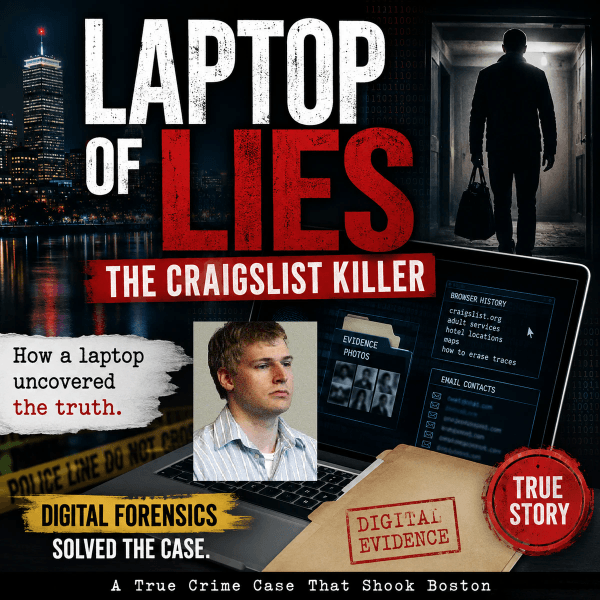
The Craigslist Killer: How a Laptop Unmasked One of America's Most Chilling Modern Murderers
In April 2009, Boston was gripped by fear.
A mysterious predator was using Craigslist to lure women to luxury hotels before robbing or attacking them. At first, investigators believed they were hunting an armed robber. Within days, however, the crimes escalated into murder, launching one of the most intensive digital forensic investigations in American criminal history.
Unlike many serial offenders who are eventually undone by eyewitnesses or DNA, this killer was betrayed by something he carried to every crime scene without giving it a second thought—his laptop.
The investigation would demonstrate how modern technology can expose even the most carefully planned crimes.
A Carefully Planned Trap
On the evening of April 10, 2009, 29-year-old Trisha Leffler checked into Boston's Westin Copley Place Hotel to meet a client who had responded to one of her Craigslist advertisements.
Nothing about the man seemed unusual.
He appeared to be a clean-cut professional in his twenties, dressed in business casual clothing and carrying a black leather laptop bag. He spoke politely, looked respectable, and gave no indication of what was about to happen.
Once inside the room, his personality changed.
Brandishing what appeared to be a handgun, he restrained Leffler using plastic cable ties before stealing hundreds of dollars in cash along with her bank cards. Strangely, after the robbery he photographed her with his BlackBerry smartphone before calmly apologising, claiming he had gambling debts.
Then he simply walked away.
Although badly shaken, Leffler managed to free herself and immediately contacted hotel security, giving detectives an excellent description of her attacker.
Investigators noticed several worrying details.
The restraints suggested careful preparation rather than impulsive violence.
The disposable mobile phone used to arrange the meeting indicated someone trying to avoid leaving a trail.
And then there was the black leather laptop bag.
Witnesses consistently remembered it.
At the time, nobody realised it would become one of the most important clues in the entire investigation.
Four Days Later, Murder
Only four days passed before tragedy struck again.
Julissa Brisman, a 52-year-old woman who advertised massage services on Craigslist, arranged to meet a client at Boston's Marriott Copley Place Hotel.
Security cameras captured a young blond man entering the building carrying the same distinctive black laptop bag.
Minutes later, hotel guests heard signs of a struggle followed by gunshots.
Brisman died from her injuries before she could be saved.
The case instantly transformed from a robbery investigation into a nationwide manhunt.
Newspapers quickly labelled the unknown attacker "The Craigslist Killer," while Boston Police established a major task force combining homicide detectives, robbery investigators and computer crime specialists.
Investigators now believed they were dealing with a highly organised offender who carefully selected victims through online advertisements before arranging meetings in expensive hotels where he could blend in unnoticed.
The Pattern Emerges
Just two days later, another woman narrowly escaped becoming the killer's next victim.
Cynthia Melton had advertised services on Craigslist from a Holiday Inn Express in Warwick, Rhode Island.
When the attacker attempted to restrain her using plastic ties, she screamed loudly enough for her husband - waiting nearby as a precaution -to intervene.
The suspect fled.
Although shaken, Melton provided investigators with another valuable witness account.
She remembered the attacker mentioning he was studying law.
It sounded like an insignificant piece of conversation.
In reality, it would become one of several clues that slowly narrowed the suspect pool.
By now detectives recognised a clear pattern.
The offender used disposable phones.
He contacted victims through Craigslist.
He favoured upscale hotels.
He carried restraints.
He transported everything in the same black leather laptop bag.
But perhaps most importantly, he was committing crimes in an age when almost every action left a digital footprint.
Following the Electronic Breadcrumb Trail
While traditional detectives interviewed witnesses and examined crime scenes, another team worked quietly behind computer screens.
Digital forensic specialists began collecting every electronic trace connected with the crimes.
Craigslist communications.
Anonymous email accounts.
Hotel electronic key-card records.
Cell phone data.
Wireless network connections.
Internet Protocol (IP) addresses.
Each individual clue seemed insignificant.
Combined, they created a remarkably detailed picture of the killer's movements.
Although the suspect believed anonymous email accounts protected him, investigators understood that every email carries hidden technical information.
Embedded within each message were IP addresses revealing where those accounts had been accessed.
Analysts soon discovered many of the emails originated from locations around Boston's Back Bay district.
The suspect clearly spent considerable time there.
Meanwhile, hotel surveillance footage allowed investigators to build an increasingly accurate profile.
The killer deliberately avoided looking directly into security cameras, yet detectives still estimated he was approximately six feet tall with short blond hair and consistently dressed in business attire.
Most importantly, every appearance featured that same unmistakable laptop bag.
The computer inside had become a silent witness accompanying every crime.
Technology Begins Closing In
As digital specialists cross-referenced email records with hotel surveillance and mobile phone data, the investigation gathered momentum.
The anonymous accounts were accessed repeatedly from similar locations.
Wireless connections consistently pointed towards Boston's Back Bay neighbourhood.
The timing suggested someone following a predictable daily routine rather than a transient criminal.
One breakthrough came when investigators traced several internet connections to educational institutions.
Others originated from apartment buildings in nearby Quincy.
Combined with Melton's recollection that her attacker claimed to be a student, detectives began investigating universities throughout the Boston area.
Boston University.
Suffolk Law School.
New England School of Law.
Harvard.
The search was narrowing.
Then the surveillance photographs were released to the public.
Within hours, a woman recognised the face.
Her name was Megan McAllister.
The man in the photographs, she told police, was her fiancé.
His name was Philip Markoff.
He was a promising second-year medical student at Boston University.
She simply couldn't believe he could be involved.
The Double Life of Philip Markoff
Friends described Markoff as intelligent, polite and ambitious.
He appeared to have everything going for him.
He was engaged to be married.
Studying medicine.
Planning a successful future.
Yet behind this respectable image, investigators soon uncovered an entirely different world.
Digital records revealed he frequently browsed Craigslist's adult services section.
He had created multiple anonymous email accounts.
He possessed numerous prepaid mobile phones.
Financial records pointed towards serious gambling debts.
Online poker activity suggested a mounting addiction.
The evidence increasingly suggested a man living two completely separate lives.
Surveillance officers soon watched Markoff leave his apartment carrying the familiar black leather laptop bag.
Fearing he might flee or destroy evidence, police moved quickly.
On April 20, 2009, just ten days after the first reported attack, Massachusetts State Police stopped his vehicle on Interstate 95.
Markoff was arrested without incident.
Inside the vehicle was the laptop bag detectives had been searching for.
It would prove devastating.
The Laptop That Told the Whole Story
Inside Boston Police Department's Digital Evidence Laboratory, forensic examiners treated the laptop with extraordinary care.
Before examining any files, specialists created an exact forensic copy of the hard drive.
Every deleted document.
Every temporary file.
Every internet search.
Every hidden fragment of data.
Nothing would be overlooked.
The results stunned investigators.
Recovered internet searches included queries about disposing of firearms, avoiding police detection and cleaning forensic evidence.
Deleted emails linked directly to communications with multiple victims.
The browser history showed repeated visits to Craigslist advertisements matching known victims.
Even more disturbing were photographs recovered from hidden folders.
Images matched surviving victim Trisha Leffler's description of being photographed after she had been restrained.
Investigators also recovered photographs connected with Julissa Brisman.
Although some files had been deleted, forensic software successfully restored them.
Digital evidence has one enormous advantage over human memory.
It rarely forgets.
Every Mistake Left a Trail
Markoff believed he had taken sophisticated precautions.
He used prepaid phones.
Anonymous email accounts.
Public computers.
Disposable identities.
Yet he made one critical mistake.
Eventually, he logged into many of those anonymous accounts using his own laptop.
That single decision connected his personal computer directly with communications arranging meetings with victims.
Investigators recovered deleted emails.
Login records.
Browser caches.
Timestamp information.
Together they formed an almost perfect timeline linking Markoff to every stage of the crimes.
The laptop itself had also connected to wireless networks inside the hotels where attacks occurred.
Its unique hardware identification, the MAC address, matched network logs preserved by hotel systems.
In effect, the computer had quietly announced its presence every time it connected to Wi-Fi.
The laptop wasn't merely evidence.
It had become an eyewitness.
Building an Overwhelming Case
Further examination uncovered maps of hotel locations.
Research into police patrol routes.
Notes relating to potential victims.
Evidence suggested Markoff spent considerable time planning attacks before making contact.
Investigators also examined his BlackBerry smartphone.
Messages sent to his fiancée claimed he was studying at university libraries during periods when digital evidence placed him inside hotel rooms with victims.
His carefully maintained alibi collapsed.
Financial records recovered from the computer reinforced another important aspect of the investigation.
Markoff had accumulated significant gambling debts through online poker accounts.
Whether financial desperation alone motivated the crimes remains debated, but investigators believed it played an important role.
By late April, prosecutors possessed one of the strongest digital evidence cases assembled to that point in American criminal history.
The electronic trail connected planning, communication, travel and the crimes themselves with extraordinary precision.
Justice Interrupted
Markoff pleaded not guilty to charges including murder, armed robbery and kidnapping.
However, the trial would never take place.
While awaiting prosecution in August 2010, he took his own life inside his jail cell.
His death denied victims' families the opportunity to see justice delivered in court.
Recognising this, Suffolk County District Attorney Daniel Conley publicly presented the evidence investigators had gathered.
Digital timelines demonstrated how Markoff's laptop connected to hotel networks during each attack.
Recovered emails linked him directly to victims.
Hidden photographs recovered from the hard drive strengthened the prosecution's case.
Even without a trial, investigators believed the evidence proved his guilt beyond reasonable doubt.
For survivors such as Trisha Leffler, knowing investigators had uncovered irrefutable digital proof offered at least some measure of closure.
A Landmark Case in Digital Forensics
The Craigslist Killer investigation permanently changed how many police departments approach criminal investigations.
Rather than treating computers and mobile devices as secondary evidence, investigators increasingly recognised them as potential crime scenes in their own right.
Today, digital forensic units routinely examine:
- Mobile phones
- Laptops
- Cloud storage
- Internet search histories
- GPS data
- Wi-Fi connections
- Smart devices
- Social media activity
The techniques refined during investigations like the Craigslist Killer case have since helped solve countless murders, kidnappings and organised crime investigations.
Ironically, the very technology Philip Markoff relied upon to plan his crimes became the instrument that exposed him.
His laptop quietly recorded searches, communications, locations and behaviour until investigators reconstructed virtually every step of his criminal activity.
It became, as one forensic investigator later described it, "a complete digital confession."
Final Thoughts
The story of the Craigslist Killer is not simply about one dangerous offender.
It marks a turning point in modern criminal investigation.
Long before smartphones continuously tracked our movements or cloud storage preserved years of personal data, investigators demonstrated that digital evidence could reveal an offender's habits, intentions and actions with astonishing clarity.
Philip Markoff believed careful planning would protect him.
Instead, every email he sent, every website he visited, every wireless network he joined and every search he performed quietly built the case against him.
In the end, the most compelling witness wasn't a person.
It was the laptop he carried into every crime scene.
And unlike its owner, it never lied.
Here's a compelling end-of-blog CTA that fits your brand and encourages readers to explore your catalogue without sounding overly promotional:
Fascinated by True Crime?
If you enjoyed this investigation, there's plenty more waiting to be discovered. Guy Hadleigh has written an extensive collection of gripping true crime books covering serial killers, cold cases, organised crime, forensic investigations, historical murders, and some of the world's most astonishing criminal mysteries.
Every case is meticulously researched and brought to life with cinematic storytelling that places you at the heart of the investigation. Whether you're fascinated by modern forensic breakthroughs or infamous crimes from history, you'll find stories that inform, intrigue and keep you turning the pages.
Explore Guy Hadleigh's growing library of true crime books and uncover the cases that continue to haunt investigators - and captivate readers - around the world.
You can find the full story and others in:
FLESH, FIRE & CODE
TRUE CRIME CASES FORENSIC INVESTIGATIONS SERIES
BOOK 1

Blog written by Guy Hadleigh, author of Crimes That Time Forgot, the Macabre True Crimes & Mysteries Series, the Murder and Mayhem Series, the British Killers Series, the Infamous True Crimes and Trials Series - and many more!