
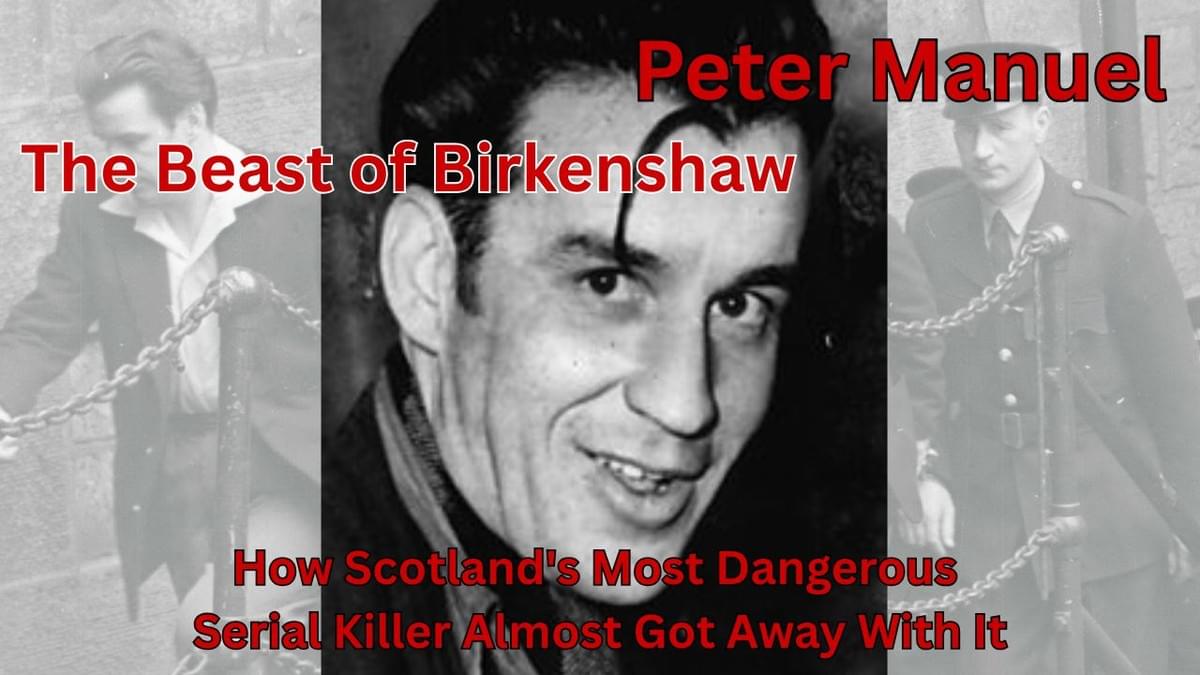
Peter Manuel - The Beast of Birkenshaw
How Scotland's Most Dangerous Serial Killer Almost Got Away With It
On the morning of Monday, 17 September 1956, a daily help named Mrs Helen Collison arrived at 5 Fennsbank Avenue in High Burnside, Lanarkshire, expecting an ordinary workday. What she found instead would set in motion one of the most chilling criminal investigations in Scottish history — and expose a calculating killer who had been hiding in plain sight for years.
The small, neatly-kept bungalow belonged to William and Marion Watt. The curtains were still drawn. The back door was locked. Mrs Collison knocked. She called out. She circled the house, growing more uneasy with every step. When she reached the front door and saw that the glass panel above the lock had been smashed, her unease curdled into dread. She looked through the hole. Every interior door in the bungalow was standing wide open.
She went inside.
What she found in the bedroom would haunt her for the rest of her life. Marion Watt and her sister, 42-year-old Margaret Brown, were lying in bed, their pillows soaked through with blood. Steeling herself, Mrs Collison pushed open the door to 16-year-old Vivienne Watt's room. The girl was in bed, head on a bloodstained pillow. As Mrs Collison approached, Vivienne gave out a single, spine-chilling groan — and died right there in front of her.
A Family Destroyed in a Single Night
Police were on the scene within minutes. They quickly established that all three victims had been shot at point-blank range with a .38-calibre revolver. There was no evidence of robbery. No sign of sexual assault. But food had been inexplicably scattered across the floor — a strange, unsettling detail that would prove to be a calling card.
The pathologist's findings painted a picture of deliberate, methodical violence. Marion Watt had a bullet wound beside her right eye. Margaret Brown had two wounds to the head. Young Vivienne had a bruise on her chin and a bullet wound beside her left eye. All wounds were ringed with powder burns. The killer had pressed the gun close — almost lovingly close — before pulling the trigger.
Superintendent Andrew McClure noted that Vivienne's right arm was twisted behind her back. Her clothing had been torn. Her wristwatch had stopped at 2.52am. The room told the story of a brief, brutal struggle before the end.
Two other break-ins had occurred in the area in the preceding days. At a house just a few doors away, money and jewellery had been stolen, soup had been poured from tins onto the carpet, and shoe marks had been left on the bedding. The same theatrical, contemptuous signature — food scattered, order violated — pointed toward a single perpetrator.
Suspicion immediately fell on a local man with a long criminal history: Peter Thomas Anthony Manuel.
The Man the Police Already Knew
Manuel was no stranger to the Lanarkshire Constabulary. At just 29, he had already accumulated a criminal record that would give any detective pause. A string of thefts, burglaries and — disturbingly — sexual offences had marked his adult life. But every time police closed in, Manuel slipped away.
When Detective Chief Superintendent Hendry obtained a search warrant and sent officers to hammer on the door of Manuel's parents' home in Birkenshaw at 2am on 18 September, Manuel calmly refused to answer their questions. His clothes were examined. The house was searched. Nothing was found. The police left empty-handed.
In a move that, in hindsight, looks almost unfathomable, they then turned their attention to another suspect entirely: William Watt, the dead women's husband and father, who had been on a fishing holiday in Argyll when his family was slaughtered.
The case against Watt seemed circumstantial at best — a ferry master and a motorist believed they had seen a man of his description on the Renfrew ferry on the night of the murders, and the bereaved man had apparently seemed "anything but grief-stricken" during the drive home from the hotel. On 22 September, William Watt was arrested and charged with the triple murder of his own family.
A Killer's Audacity
Here is where the story takes a turn that seems almost impossible to believe.
On 2 October 1956, Peter Manuel was sentenced to 18 months in prison for an attempted colliery burglary and was sent to Barlinnie Prison — the same prison where William Watt now languished, wrongly accused of killing his wife, daughter, and sister-in-law. Manuel found Watt there and began to taunt him. He claimed he knew who the real killer was.
He then wrote to Watt's solicitor, Laurence Dowdall, requesting a visit. When Dowdall came, Manuel shared details about the crime that had never been published in any newspaper. Dowdall, a seasoned legal mind, was immediately certain that the only way Manuel could know these things was if he had been there himself. But when pressed, Manuel refused to name himself — instead, he played the informant, hinting and suggesting, dangling the truth just out of reach.
It was a performance of extraordinary arrogance. Here was a man who had shot three women in their beds, watched an innocent man go to prison for it, and then inserted himself into the investigation for — what? Thrill? Power? The sheer delight of being at the centre of things?
Police interviewed Manuel again. He refused to cooperate. An informant told them Manuel had acquired a gun before the murders. They searched his home a second time and found nothing. In December 1956, after 67 days in custody, William Watt was released. Nearly a year later, Manuel walked free too.
The Bodies Were Already Piling Up
What the public didn't fully know — and what the police were only beginning to connect — was that this wasn't Manuel's first kill.
Nine months before the Watt murders, on 2 January 1956, a 17-year-old girl named Anne Knielands had set out from her home near East Kilbride to catch a bus to a dance. She never arrived. Her body was found the next afternoon by a labourer searching for golf balls on the fifth fairway of East Kilbride golf course. Her head had been savagely beaten. Her clothing had been disturbed. She had not been sexually assaulted, but semen stains were found on her clothes. Pieces of her skull were scattered nearby.
The man who led the labourer to the nearby Gas Board work gang to raise the alarm? Peter Manuel, who happened to be working there that day.
When police noticed scratches on Manuel's face and brought him in for questioning, he explained them away as injuries from a New Year's Eve brawl. His father confirmed he had been home on the evening of the murder. His clothes were examined and nothing found. Once again, he walked.
The Anne Knielands file remained open and cold. But Superintendent Hendry never stopped thinking about Peter Manuel.
1957: The Killing Season
Then came the winter of 1957, and with it, a fresh horror.
On 29 December, 17-year-old Isabelle Cooke set out from her home in Mount Vernon to attend a Saturday night dance. She never came home. A shoe, a handbag and personal belongings were found in a flooded colliery shaft, but no body. Her fate was grimly certain, but officially unknown.
Eight days into the new year, on 6 January 1958, police broke into a bungalow at 38 Sheepburn Road in Uddingston after the family's car was found abandoned in Glasgow. Inside, they found civil engineer Peter Smart, his wife Doris, and their 11-year-old son Michael — all shot through the head at close range. The family had been dead since New Year's Day. But in the days between, someone had been opening and closing their curtains, switching their lights on and off, moving through their home as though it were his own.
An open tin of salmon sat on the kitchen counter.
Chief Inspector William Muncie, who had been quietly working the Knielands case for two years, made the connection immediately. Eleven years earlier, he had caught a burglar returning to the scene of his own crime. That burglar had been Peter Manuel.
The Confession
On 13 January 1958, police searching Manuel's home found a Kodak camera and a pair of gloves, both stolen from a house in Mount Vernon. Manuel's father Samuel claimed he had bought them at a market. He was arrested and charged with receiving stolen goods.
It was the arrest of his father that finally broke Peter Manuel.
On 15 January, he told police that if his father was released, he would make full admissions. "Bring my father and mother here," he said. "After I have made a clean breast with them I will clear up everything for you and take you to where the girl Cooke is buried."
He waived his right to a solicitor and began to write. He confessed to killing the Smart family. He confessed to killing Isabelle Cooke. He confessed to killing Anne Knielands. He confessed to killing Marion Watt, Vivienne Watt, and Margaret Brown.
That night, shortly before midnight, Manuel led police to a ploughed field in Mount Vernon and showed them where he had buried Isabelle Cooke. He showed them where he had thrown the murder weapons into the River Clyde. He led them to the piece of iron he had used to beat Anne Knielands to death. When Isabelle Cooke's body was unearthed, she was dressed in only a cardigan, suspender belt and nylons. A brassiere was tied tightly around her neck. A headscarf was knotted around her face, the knot tucked into her mouth.
The Trial of the Century
Peter Manuel's trial opened at Glasgow High Court on 12 May 1958. He faced eight charges of murder. He pleaded not guilty to every one of them.
In a move that stunned the courtroom, Manuel sacked his legal team midway through proceedings and chose to conduct his own defence. For 150 minutes, without a single note, he addressed the jury. He argued that his confessions had been extracted through police threats to his family. He claimed the Watt murders had been carried out by a man named Charles Tallis. He presented alibis. He cross-examined witnesses with a skill and composure that led the presiding judge to remark, before the jury retired, that "the accused has presented his own defence with a skill that is quite remarkable."
It wasn't enough.
The jury returned unanimous guilty verdicts on all charges. On 30 May 1958, Peter Manuel was sentenced to death for seven murders. An appeal on 24 June failed. On 11 July 1958, he was hanged at Barlinnie Prison. He was 31 years old.
Who Was Peter Manuel?
Peter Thomas Anthony Manuel was born in New York City in 1927 to Scottish parents. The family returned to Scotland during the Depression and later moved to Coventry, where young Peter — small, solitary, marked out by his American accent — struggled to fit in and made no friends.
His first recorded crime came at age 11, when he stole from a chapel offertory box. It escalated quickly. Thefts, burglaries, reform schools, Borstals. At 15, while on the run from Borstal, he battered a woman with a hammer during a burglary. Shortly afterwards, he committed his first indecent assault. At 19, he stood trial on 15 burglary charges and — conducting his own defence — was also convicted of two indecent assaults and rape. He received eight years.
Released in 1953, he returned immediately to crime. One of his peculiar trademarks was scattering food over the floors of houses he burgled — an act of contempt, or perhaps theatre, that linked him to multiple crime scenes.
Psychologists have long debated what drove Manuel. He was not in burglary for profit in any straightforward sense — the money was almost incidental. What he seemed to crave was the sensation of moving through the world undetected, of operating in darkness, of being noticed and talked about while remaining just beyond reach. The murders may have been an escalation of that need: the ultimate assertion of power over another human being. The ultimate thrill.
He nearly got away with it — not once, but repeatedly. The scratches on his face after the Knielands murder. The food scattered at the Watt home. The months of taunting William Watt in prison. The meetings with Dowdall. The details he volunteered that no innocent man could have known.
Peter Manuel wanted to be the smartest person in every room. In the end, it was his father's arrest — the one variable he couldn't control — that brought him down.
A Legacy of Fear
The case of Peter Manuel — the "Beast of Birkenshaw," as he came to be known — remains one of the darkest chapters in Scottish criminal history. Seven confirmed murders across three years. A galaxy of near-misses that haunts every detective who has ever studied the case. Police in County Durham were waiting at the appeal court doors to charge him with an eighth killing — the murder of a Newcastle taxi driver whose throat had been cut on a lonely moorland road — had his appeal succeeded.
It didn't. Justice, this time, moved faster than he did.
Mrs Helen Collison, the daily help who walked into 5 Fennsbank Avenue on that September morning and found a family destroyed, was an ordinary woman thrown into an extraordinary and terrible situation. She went back into that house, room by room, when any rational person might have fled. She was there when Vivienne Watt took her last breath.
History doesn't record much else about Mrs Collison. But it was her persistence — her refusal to simply turn away — that set everything in motion. In a case defined by darkness, that small act of courage deserves to be remembered too.
YOU CAN READ THE FULL PETER MANUEL STORY, PLUS 8 OTHER COMPELLING AND SHOCKING SERIAL KILLER TALES IN:
British Killers - Volume 3: Nine Horrific True Crime Stories From The UK...And How They Were Solved
