
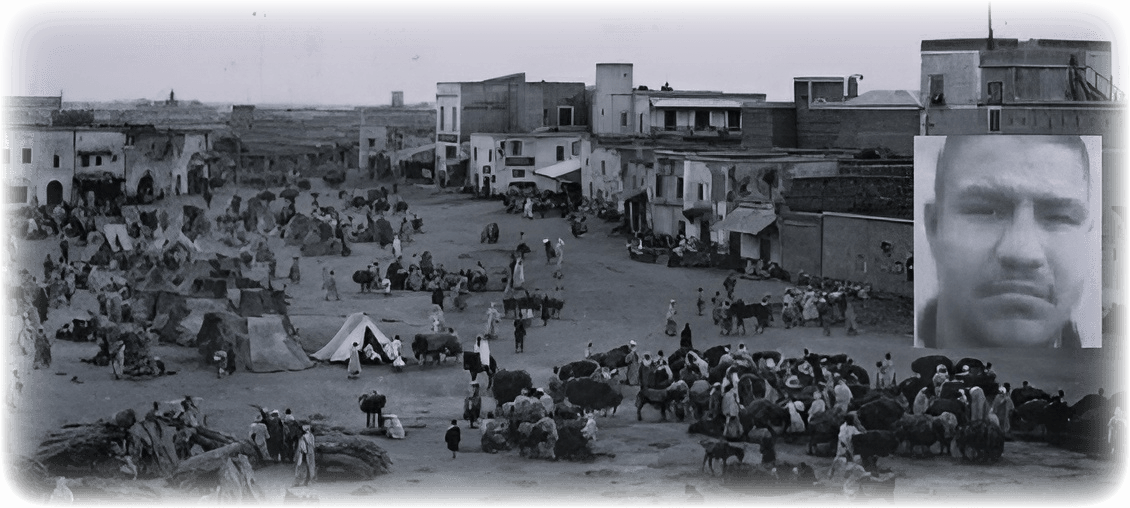
The Serial Killer Cobbler of Marrakesh
Hadj Mohammed Mesfewi murdered and buried thirty-six women beneath his shop floor. Then a city walled him alive — and the world watched.
Marrakesh, June 11, 1906. The Djemaa el-Fna — the great square at the heart of the medina — is packed before the sun has cleared the rooftops. The storytellers and snake charmers are gone. This morning the crowd has come for something else.
Two masons have been working since dawn on a section of the bazaar wall. They have cut a niche into the ancient masonry — two feet deep, two feet wide, six feet high — and fixed chains to its back wall. On the floor of the opening sit a small loaf of bread and a vessel of water. The chief jailer places these himself. In the grim arithmetic of what is about to happen, this passes for mercy.
The procession arrives from the city jail. The man at its centre has spent the past four weeks being flogged every morning in this same square — ten strokes of thorny acacia switches, his wounds dressed with vinegar and oil so they would heal just enough to be torn open again the following day. He has endured this with a fatalistic stillness that unnerved the crowds who watched. He had hoped, it was said, that his heart would give out under the thorns. It refused.
Now he turns the corner into the square, sees the niche, sees the bricks stacked beside it, sees the thousands of faces pressing in, and understands for the first time what this morning actually is. He begins to scream.
His name is Hadj Mohammed Mesfewi. He is a cobbler. He is also, as the thirty-six bodies found beneath his shop and in his garden have established beyond any doubt, the most prolific serial killer in Moroccan history — and the last man in recorded history to be executed by immurement: sealed alive into a wall, in full view of a city he had terrorised for years behind the face of an ordinary man.
The Man Inside the Souk
To understand how Mesfewi operated for as long as he did, you need to understand Marrakesh in 1906.
The city was a walled metropolis of roughly 100,000 people — the commercial heart of southern Morocco, its souk one of the great trading confluences of the Islamic world. Merchants, pilgrims, travellers, and residents moved through its labyrinthine alleys in a daily flow that made individual surveillance almost impossible. The Moroccan royal administration, the Makhzen, was stretched thin across a country under intense external pressure. Disappearances were common. Sustained municipal investigation into the fate of a single woman was simply not available to the authorities.
Into this world, Mesfewi had inserted himself with a craftsman's patience.
He was, by most accounts, a man of middle years and unremarkable means. His primary trade was the repair and making of traditional slippers. His secondary income came from operating as a public letter-writer — a genuine social service in a city where literacy was uneven. People who could not compose their own correspondence came to him with their private matters: family disputes, commercial dealings, letters home. He listened. He helped. He cultivated trust with the deliberate care of a man who understood exactly what trust was worth.
His shop was a place where women came alone, and came willingly, and left quietly, and were not immediately missed in a city large enough to absorb a disappearance without flinching.
Tea, a Dagger, and the Pit Beneath the Floor
The method was consistent and efficient.
Mesfewi operated with an accomplice: a seventy-year-old woman known as Annah, who served as both lure and logistical partner. Together they would identify a target — younger women, generally — and invite her to Mesfewi's shop on the pretext of dictating a letter, or to his home for a meal. At the appointed time, the woman would be given wine or tea laced with a narcotic, most likely an extract of cannabis or opium. When she lost consciousness, Mesfewi went through her possessions. Then he killed her with a dagger.
The sums were almost invariably small. A few coins. A cheap ring. A length of fabric.
The financial logic of thirty-six murders for modest individual gain implies either a compulsive pathology that the financial motive was used to explain after the fact, or a degree of desperation that drove a man to repeat an act that could not, arithmetically, have made him wealthy. His confession — extracted under duress, after Annah herself died under torture but provided enough information to confirm his involvement — has limited reliability on the matter of precise motive. What cannot be doubted is the physical evidence: twenty decapitated bodies exhumed from a pit beneath the shop floor. Sixteen more found in the garden of a nearby property he owned. Thirty-six women, confirmed. Possibly more.
The discovery came in mid-April 1906, when the parents of a young woman who had gone to Mesfewi's shop to dictate a letter and never come home reported her disappearance to the Makhzen. The investigation that followed was swift, and the excavation, once begun, kept producing. The news moved through Marrakesh the way catastrophic news moves through a closed community: first disbelief, then the reordering of memory — neighbour after neighbour recalling a woman who had visited the cobbler's and never been seen again — and then the specific, concentrated fury of a city that had trusted a man for years and understood, only now, what that trust had enabled.
The Sentence That Became the News
The investigation, by the standards of the era, was thorough and swift. The physical evidence was overwhelming. What made the Mesfewi case internationally significant was not the crime but the sentencing — a legal process that became a diplomatic flashpoint at the precise moment when Morocco's sovereignty was the subject of the most consequential conference of the decade.
Earlier that year, in January 1906, the great powers of Europe and the United States had convened in Algeciras, Spain, to negotiate Morocco's effective subjugation. The Act of Algeciras, signed on April 7, formalised French and Spanish police control over Moroccan cities. Sultan Abdul Aziz, ruling from Fes, had no telephone, no telegraph, and no paved road connecting him to deliberations that were disposing of his kingdom.
The initial sentence handed down for Mesfewi was crucifixion, scheduled for May 2, 1906. European diplomats resident in Marrakesh reacted with immediate and forceful objection. Crucifixion was barbarous, they said. An affront to civilised standards. The sentence was changed to beheading, which the diplomats considered acceptable. The people of Marrakesh did not, and said so with sufficient force that the authorities faced a genuine dilemma: a population demanding proportionate suffering for a man who had murdered thirty-six of their daughters and sisters, and a foreign community threatening consequences for any punishment they deemed uncivilised.
The solution — bearing the Sultan's personal signature — was a compromise of peculiarly Moroccan character. Mesfewi would not be crucified. He would not simply be beheaded. He would be publicly flogged every morning for four weeks: ten strokes of thorny acacia switches, wounds dressed with vinegar and oil to ensure healing just sufficient for the next session to reopen them. Then he would be immured — walled alive into the bazaar wall in full public view, with bread and water enough to extend his dying over days rather than hours.
The floggings began on May 15. Twenty-eight sessions. Two hundred and eighty strokes. Mesfewi endured them with what observers called fatalistic stoicism, reportedly hoping to die under the thorns. His body refused. By June 11, he was a man stripped of flesh and dignity over a month of public suffering — and yet, at the sight of the niche in the wall and the stack of fresh bricks, still capable of screaming and fighting and begging.
He was dragged to the opening, chained upright inside it, and the masons stepped forward.
The crowd threw offal and filth at him as the first courses of brick went up. He screamed through the afternoon and through the night and through the following day. On the morning of June 13, 1906, his voice fell silent. The masons came back and completed the wall. The Djemaa el-Fna returned to its business.
The European diplomatic community, which had intervened to prevent crucifixion, filed no protest against immurement. Whether this represented a calculation that immurement, being less visually immediate than crucifixion, satisfied the letter of their objection while permitting the spirit of communal vengeance — or whether they had simply exhausted their appetite for interference — is not recorded. What is recorded is that the masons completed their work undisturbed.
The Thirty-Six Had No Names in the Papers
The international press coverage was extensive and, by the standards of its time, sensational. American and European newspapers published accounts sourced from diplomatic cables out of Tangier. Editorial writers on both sides of the Atlantic used the case as ammunition for their respective arguments: those favouring European colonial intervention cited Mesfewi's unpunished years as proof the Makhzen could not protect its own people; those opposing colonialism noted that the sentence demonstrated a system of justice with its own internal coherence, however alien to European sensibilities.
Neither argument served the thirty-six women buried in a pit beneath a cobbler's floor.
Annah — who had lured Mesfewi's victims and who died under torture before she could be formally tried — has no recorded legal resolution. She was never sentenced, never convicted, never memorialised.
The victims themselves are known almost entirely as a collective number. Their individual names are absent from the historical record. Their identities were absorbed entirely into the notoriety of the man who killed them. This erasure is not incidental. It is the condition of being a poor woman in a pre-colonial city at the turn of the twentieth century, and the condition of being a victim whose value to history was defined entirely by her perpetrator.
Morocco became a French protectorate in 1912. The medina of Marrakesh — including the bazaar where Mesfewi was sealed into its ancient walls — is now a UNESCO World Heritage Site. The exact section of wall is unmarked. Whether it still stands, or was demolished and rebuilt in the century since, is not documented. The Djemaa el-Fna still receives millions of visitors each year: storytellers, snake charmers, the smoke of a hundred food stalls, the compressed noise of a place where the distance between the sixth century and the twenty-first is sometimes no wider than a single alley.
What Justice Is For
The Mesfewi case leaves behind, beyond its grim inventory of crimes and the spectacle of its punishment, a question about what justice is actually for.
The foreign diplomats who objected to crucifixion and accepted immurement had drawn a line that was entirely arbitrary — defined by aesthetic discomfort rather than principle. The crowds who threw offal at a chained man while masons sealed him into a wall had satisfied something genuine: a grief and a rage that had been building since the first woman went to a cobbler's shop to dictate a letter and did not come home. But that satisfaction did not produce any answer to why it had been allowed to continue for years. The Makhzen had no explanation to offer. The diplomatic community had no interest in pursuing one. The European press had its story about Moroccan barbarism and moved on.
The thirty-six dead had no names in the newspapers. They had no monuments. They had nothing except the knowledge — which they did not live to receive — that the man who killed them died screaming in a wall for two days, watched by a city that needed to see it and would remember it for a hundred years.
The wall eventually came down. The victims never came back.
Hadj Mohammed Mesfewi was executed by immurement in Marrakesh on June 11, 1906. He is considered the last person in recorded history to be executed by this method. The names of his thirty-six confirmed victims are unknown.
For more cases from the darkest corners of history, the complete Macabre True Crimes and Mysteries series is available on Amazon here https://mybook.to/keaO
You can read the full story of The Serial Killer Cobbler of Marrakesh, plus 19 other fascinating and compelling tales in Volume #5 here

Blog written by Guy Hadleigh, author of Crimes That Time Forgot, the Macabre True Crimes & Mysteries Series, the Murder and Mayhem Series, the British Killers Series, the Infamous True Crimes and Trials Series - and many more!